Outsourcing Consulting News
Offshore Application Integration Services
Almost all Fortune 2000 companies are planning several major IT projects in the next several years. Some of them will include Online E-Commerce, B2B, B2C, integration of new with existing ERP systems, acquisitions or redesign changes, business intelligence, CRM and mobile solutions.
Most of these new systems will be implemented using the data of today's legacy systems, which leads to integration of these applications.
Application Integration cost can be divided in three parts:
- Architecture cost from integration development, execution and operational environment set up. It includes the license, new hardware and implementation costs.
- Integration cost from development of the number of interfaces and communications between systems.
- Operating cost from on-going maintenance of the EAI system.
Why companies integrate their applications?
To support their business workflows and data exchange across several applications, companies need to integrate these applications.
The main goal is to provide scalable and reliable data exchange between multiple enterprise applications with functions across multiple software packages with flexibility in using accounting software, CRM or E-Commerce package that suits the company' needs.
SoloSoft’s offshore development service and solutions to clients are centered on our Web Services expertise.
There are typically three reasons in using application integration tools over using APIs:
- Evolving technology. Using application integration tools would easy the pain in performing the work in comparing in using APIs.
- Maintenance of the integration of the existing applications. It takes too long to maintain integration of application than use an EAI tool.
- Scalability of your corporate solution. When your company solution evolves, it's too difficult to use API in comparing a EAI tool. A typical API merely allows to implement a full featured communication exchange with a third party application or component. From other side a suite of EAI services performs event exchange, routing, connectivities, and business workflows implementation.
Below is a solution from Sun Microsystems - J2EE(TM) Connector Architecture that specifies a standard architecture for accessing resources in diverse Enterprise Information Systems (EIS).
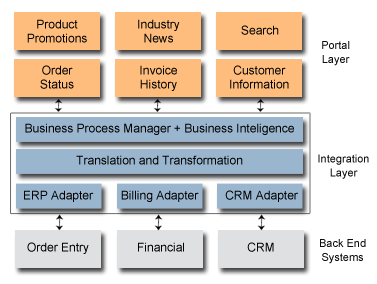
An example of integration portal with other applications (CRM, ERP, Legacy, etc).